Moisture Requirements:

MoistureContentByArea
• Moisture testing for wood subfloors should be done at several locations in the room - a minimum of 20 per 1,000 square feet. A high reading in one area indicates a problem that must be corrected.

• An acceptable vapor retarder is a vapor resistant material, membrane or covering with a vapor permeance (perm rating) of greater than or equal to .7.

• Install a vapor retarder over wood panel or board sub-floors prior to installing nail down solid strip or plank flooring. Over-lap seams a minimum of 4 inches or more as required by manufacturer or specifier and local building codes.

• Some examples of acceptable vapor retarders over wood subfloors include:

  • An asphalt laminated paper.
  • Asphalt-saturated kraft paper.

• A vapor retarder has some extra benefits in that it eliminates wood-on-wood contact, wood strips slide more easily when positioned, minimizes the impact of seasonal humidity change and may reduce dust and noise levels.

• Over a wood subfloor, do not use an impermeable vapor retarder material with a perm rating of .7 or less, such as 6 mil polyethylene film or other polymer materials, as it may trap moisture on or in the wood subfloor.

• Do not use common red rosin or building paper which is not asphalt saturated. They are not vapor retarders.

• Before moisture testing begins, the concrete slab must be a MINIMUM of 30 days old.

• If the moisture meters indicate the presence of excessive moisture, as per wood flooring or meter manufacturer's recommendations, further testing is required.

• For slabs on grade and below grade, include a test location within three feet of each exterior wall.

• In on-grade and below grade applications, adding a vapor retarder is always recommended.

• The NWFA recommends an "impermeable" vapor retarder with a perm rating of less than or equal to .15, thereby limiting the passage of moisture to near zero.

• A minimum 6 mil construction grade polyethylene film, with perm of .13, or other impermeable material with a perm of .15 or less is recommended. A premium polymer material for concrete with higher tensile, tear and puncture resistance is highly desirable.

• A chemical retarder or urethane membrane, as recommended by the adhesive or wood flooring manufacturer. These are usually in the form of a liquid-applied or trowel-applied membrane dispensed from a bucket following manufacturer recommendations.

• For solid strip flooring (less than 3" wide), there should be no more than 4 percent moisture content difference between properly acclimated wood flooring and subflooring materials.

• For wide solid flooring (3" or wider), there should be no more than 2 percent difference in moisture content between properly acclimated wood flooring and subflooring materials.

• Make sure the concrete slab is flat to the wood flooring manufacturer's specification.


Equilibrium Moisture Content of North American Wood Species
at Various Temperatures and Relative Humidity Readings

Wood Flooring Has a Comfort Level Too: Wood flooring will perform best when the interior environment is controlled to stay within a relative humidity range of 30 to 50 percent and a temperature range of 60° to 80° Fahrenheit. Fortunately, that's about the same comfort range most humans enjoy. The charts below indicate the equilibrium moisture content of North American species of wood under various temperature and humidity conditions. These values do not necessarily apply to imported species.

The left column indicates temperature in degrees Fahrenheit and Celsius. The bottom row indicates percent relative humidity. The values in the chart indicate the equilibrium moisture content (EMC) for any given combination of temperature and humidity. For example, at 70° Fahrenheit and 40% relative humidity, the equilibrium moisture content is 7.7%.
The shaded area indicates the generally recommended range for wood flooring — 6-9% EMC, which occurs when temperature is 60-80° Fahrenheit or 15-26° Celsius and 30-50% relative humidity.


HumidityChart

Wood Subfloor:


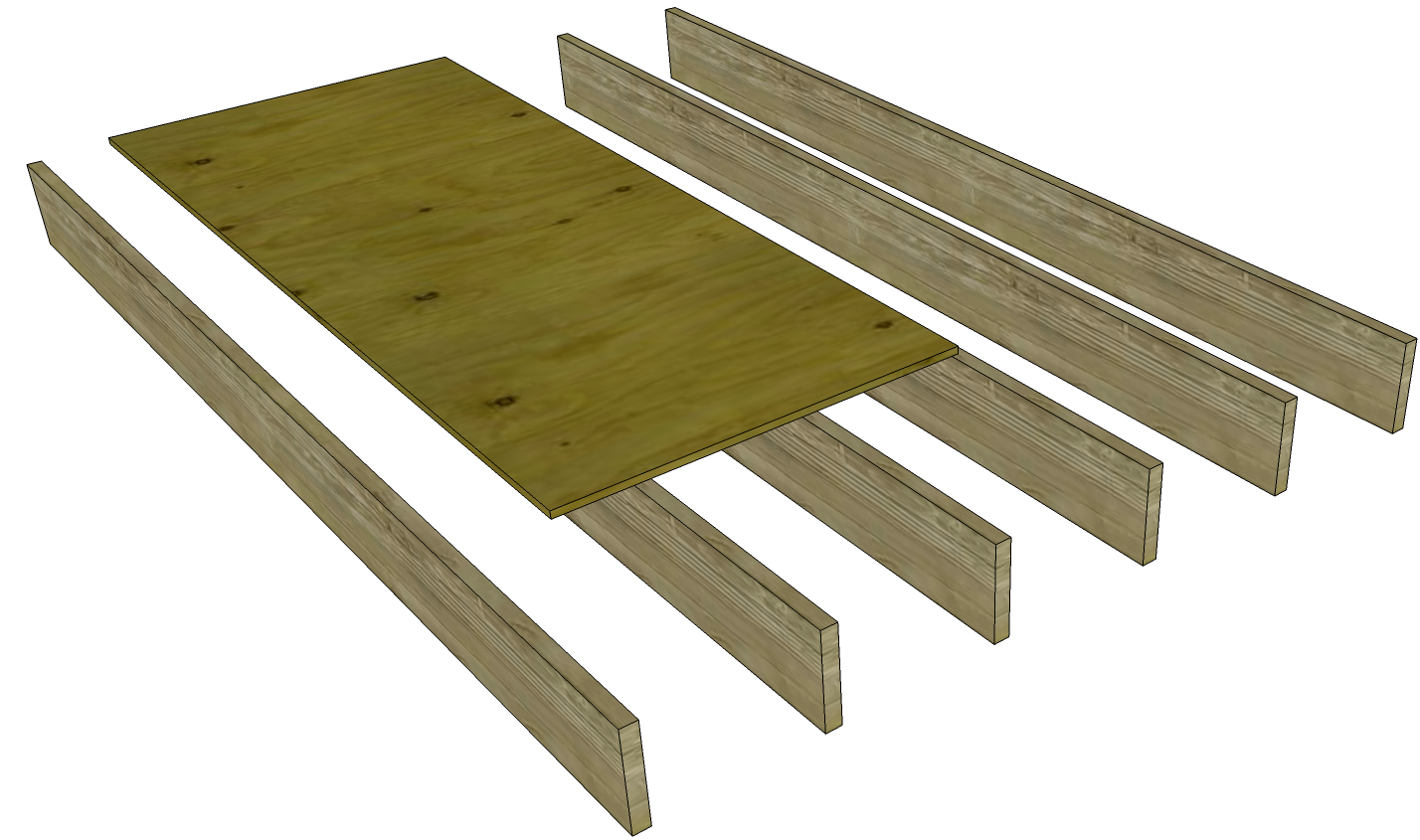
• Make sure the subfloor is free of debris before beginning installation.WoodSubFloor

Solid-board subflooring should be ¾", kiln-dried to less than 15 percent moisture content.

• For solid strip flooring (less than 3" wide), there should be no more than 4 percent moisture content difference between properly acclimated wood flooring and subflooring materials.

• For wide-width solid flooring (3" or wider), there should be no more than 2 percent difference in moisture content between properly acclimated wood flooring and subflooring materials.

• Ensure that there is proper expansion space (1/8") between the panels. For double-layer subfloors, the first layer should consist of nominal ¾" plywood subfloor panels
or OSB sheets. The second layer should consist of nominal ½" plywood.

Installation Over Existing Floors

• Glue-down parquet applications that require the use of PVA adhesives are not recommended over existing sheet vinyl or vinyl and cork tile flooring unless an underlayment is put down first. Underlayment should be in accordance with adhesive and/or flooring manufacturer's recommendations.
• Particleboard is not generally an acceptable underlayment, because it lacks stability.
• Other types of adhesives may require the use of a primer or vinyl blocker when installing over sheet vinyl or vinyl and cork tile flooring. Follow manufacturer's recommendations.
• Nail-down applications may be successful over existing sheet vinyl or vinyl tile if fastener penetration is not significantly diminished and the subfloor meets minimum requirements. Fasteners must penetrate a proper subfloor by at least 5/8".
Wood flooring can be installed over existing ceramic tile, terrazzo, or marble with proper underlayment or adhesives only on manufacturer's recommendation.


Installing wood flooring over an existing wood floor.

• Sand off old finish and high spots on existing wood floor and prep to clean, dry, sound, flat subfloor. Repair, re-nail or replace loose flooring products.
• Over an existing glue-down floor, glue direct to the existing floor. Or, if the thickness of the floor will allow it, staple to the existing floor. Check with the flooring manufacturer for recommendations.
• When installing new wood flooring parallel to an existing solid nail-down floor, add minimum of 3/8" underlayment over the existing floor to increase stability.
• When installing new wood flooring at a 45- to 90-degree angle to an existing solid nail-down floor, additional underlayment is not required.

AvoidHJointStaggerEndJointSolid Hardwood:


• Always follow the manufacturer's recommended installation procedure.
Solid plank wood floors can be installed successfully above grade level or on grade, but are not recommended for installation below grade.
• Unfinished and factory-finished solid flooring should be installed perpendicular to the joists or on a diagonal for any single layer subfloor.
• Before installing wood flooring, place an approved vapor retarder such as:
o An asphalt laminated paper or Asphalt-saturated kraft paper.
• As a general rule, a ¾" expansion space must be left around the perimeter and at all vertical obstructions.
• Racking rule of thumb: Avoid "H" patterns. Stagger end joints of boards row to row a minimum of 6" for strip flooring, 8-10" for 3" to 5" planks, and 10" for plank wider than 5".
• Top-nail and blind-nail the first row (hand-nail if necessary), using appropriate fasteners.
• Nailing: Blind-nail through the tongue using 1½"-2" fasteners. Use 1½" fasteners with nominal ¾" plywood subfloor direct to concrete slab.
• For wide-width plank flooring (5" or wider), to assist the nailing schedule of 6"-8" and increase holding power.


Radiant Heat Installations

• With radiant heat, the heat source is directly beneath the flooring, so the flooring may dry out faster than a similar floor in a home with a conventional heating system. Wood flooring can be installed over radiant heat as long as you understand radiant heat and how it can impact wood flooring, what precautions to take, and what type of wood flooring to use.
• Types of wood flooring that are best suited-for radiant heat subfloor are products that possess improved dimensional stability such as:
Engineered wood flooring is more dimensionally stable than solid wood flooring.
• Certain species are known for their inherent dimensional stability such as North American oak, American cherry, American walnut and others. Denser species such as Maple and Brazilian Cherry are less stable.
• Quartersawn and rift-sawn wood flooring is more dimensionally stable in width than plain sawn wood flooring.
• Narrow boards are more dimensionally stable than wide boards.
• To minimize the effect that rapid changes in temperature will have on the moisture content of the wood floor, NWFA recommends that an outside thermostat be installed.
• Unlike conventional heating systems, which switch on as needed, radiant systems work most effectively and with less trauma to the wood floor if the heating process is gradual, based on small incremental increases in relation to the outside temperature.
• Subfloors should have proper moisture tests according to the moisture testing procedures.
• The essential requirement in proper applications of wood flooring over radiant heated systems is to avoid penetration of the heating element. Radiant-heated subfloor systems can be concrete, wood or a combination of both.
• If the subfloor is concrete and it has cured, turn the heat on, regardless of season, and leave it on for at least 5-6 days to drive out residual moisture before installation of the wood flooring. Some installation systems, particularly glue-down applications, require the heat to be reduced or even turned off before installation of the flooring begins, so the adhesive does not cure excessively.
• If flooring materials that conduct heat at different rates are on the same circuit or heating zone, check with the HVAC mechanical engineer before proceeding.
• Radiant heat is dry heat. A humidification system may be necessary to maintain wood flooring in its comfort zone.

The following installation and subfloor systems can be used successfully over radiant heat:

1. Glue-down, engineered or solid parquet
2. Floating engineered
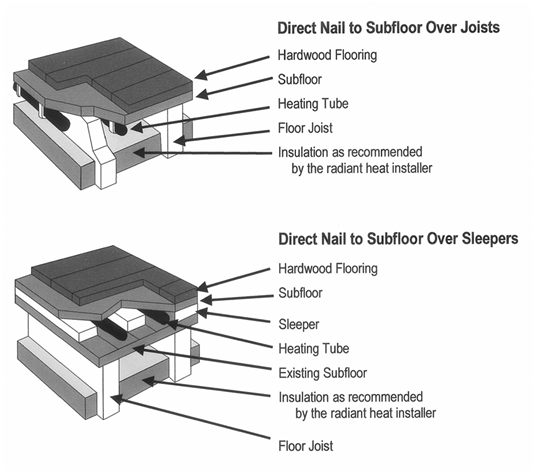
3. Direct-nail, solid wood or engineered wood flooring to wood subfloor
4. Solid T&G floor direct-nail to sleepers
5. Single layer of plywood on sleepers
6. Double plywood floating subfloor
7. Loose-lay single layer of ¾" plywood cut in 16" planks staggered with ½" gap between laid perpendicular to wood direction.

GLUE-DOWN, ENGINEERED OR SOLID PARQUET
NOTE: Follow manufacturer's installation instructions.

Engineered Flooring Installation.


• Use an adhesive approved by the manufacturer.
• The heating system has to be turned off before installation.
• The maximum allowable subfloor surface temperature is 29.5° C.
• Expect some heating season shrinkage.


DIRECT NAIL, SOLID WOOD OR ENGINEERED TO WOOD SUBFLOOR


• Install over approved subfloor.
• Always check for subfloor moisture.
Solid wood must be properly acclimated to normal living conditions.
• Be sure fasteners are not so long as to penetrate heating elements.
• Maximum subfloor surface temperature 29.5° C.


RadiantHeat1


SOLID T & G FLOOR DIRECT NAIL TO SLEEPERS

RadiantHeat2

• The use of solid wood flooring 4 inches and wider is not recommended over sleepers.
• Solid wood must be properly acclimated.
• Cannot use shorts.
• Maximum subfloor surface temperature 29.5° C.


SINGLE LAYER OF PLYWOOD ON SLEEPERS

• Solid wood must be properly acclimated.
• Maximum subfloor surface temperature 29.5° C.

FLOATING ENGINEERED

RadiantHeat5

• Install over approved subfloor.
• A 6 mil or better polyethylene vapor retarder should be installed over concrete subfloors. In some cases, this may be part of the flooring underlayment.
• A foam or resilient underlayment recommended by the flooring manufacturer must be installed prior to application of the wood flooring.
• Use an adhesive approved by the manufacturer for side and/or end joints.
• Maximum subfloor surface temperature 29.5° C.

Proud Member of

NWFA-Logo